




Skip to content
Sumanth Tangirala

Sumanth Tangirala

Robotics PhD StudentRutgers University

Research

I work on data-driven reachability analysis for verifying robot controllers. Instead of relying on a model of the controller, I use its own executions to estimate the states from which it reaches its goal without failing, and how likely it is to do so when the dynamics are noisy. These estimates can be calibrated to carry statistical guarantees. Because they only need data, they work for black-box controllers such as reinforcement learning or behavior cloning policies, whose internals can't be analyzed directly.

This builds on my earlier work in the lab on planning and control for robots with complex dynamics, and on estimating controllers' regions of attraction from data.

Currently

PhD student in Prof. Kostas Bekris's PRACSYS Lab, Rutgers University

PRACSYS Lab, Rutgers UniversityZooxTekionISRODA-IICT

Publications

Uncertainty-Aware Reach-Avoid Estimation with Statistical Guarantees

Sumanth Tangirala*, Dhruv Metha Ramesh*, Ewerton R. Vieira, Abdeslam Boularias, Ying Hung, Kostas E. Bekris
Under review at the Learning for Dynamics and Control Conference (L4DC), 2027 · * Equal contribution

Predicts reach-avoid outcomes or abstains, with finite-sample bounds on the error rates of its predictions.


GRAPE: Generative Reach-Avoid Probability Estimation for Black-Box Robot Controllers under Stochastic Dynamics

Sumanth Tangirala*, Dhruv Metha Ramesh*, Ewerton R. Vieira, Abdeslam Boularias, Ying Hung, Kostas E. Bekris
Under review at the IEEE International Conference on Robotics and Automation (ICRA), 2027 · * Equal contribution

Estimates reach-avoid probabilities under stochastic dynamics from a flow-matching terminal-state model.

Integrating Explicit and Implicit Models for Robot Motion Generation

Kostas E. Bekris, Joe Doerr, Patrick Meng, Sumanth Tangirala
Proceedings of the International Symposium of Robotics Research (ISRR), 2026

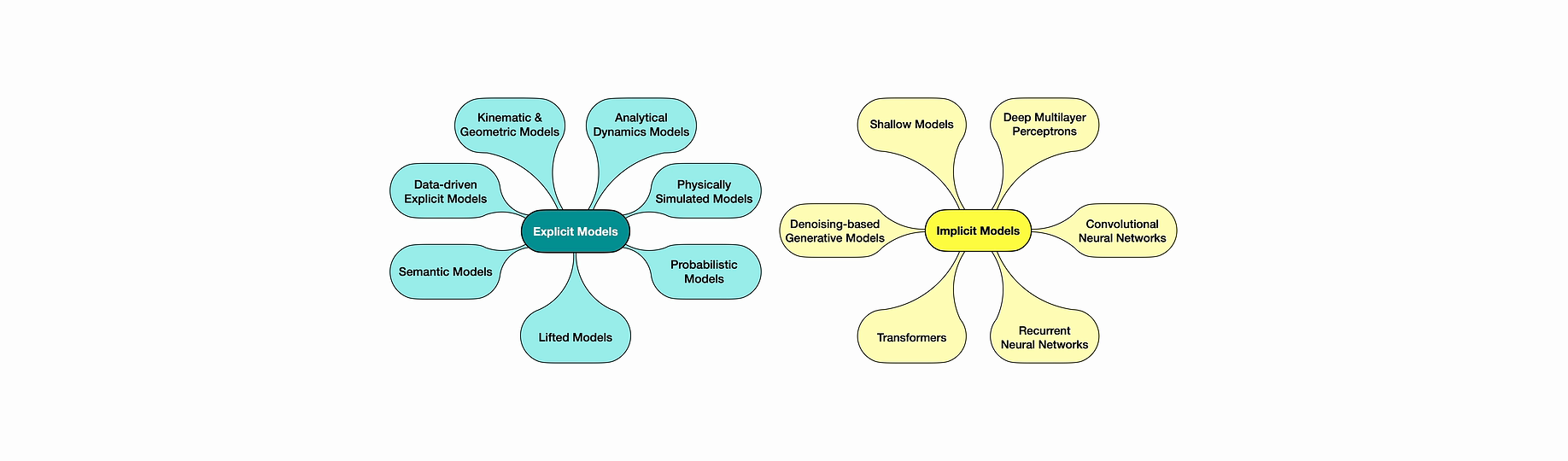
A follow-up to the 2024 survey that reviews methods combining explicit models with implicit, learned ones. It sorts them into four families by how tightly the two are coupled: sequential pipelines, parallel residuals, hierarchical decompositions, and embedded architectures.

My roleCo-wrote the taxonomy of integrative methods, finding the work that belongs under each family and proposing new splits within them.

Kinodynamic Trajectory Following with STELA: Simultaneous Trajectory Estimation & Local Adaptation

Edgar Granados, Sumanth Tangirala, Kostas E. Bekris
Proceedings of the Robotics: Science and Systems (RSS) Conference, 2025

A trajectory-tracking controller for robots with arbitrary dynamics: it keeps the robot on its planned trajectory despite noisy observations by jointly estimating its recent trajectory and adapting its controls. Unlike pure tracking, it can deviate from the plan to avoid obstacles. Estimation and control run online at 10 Hz or more.

The State of Robot Motion Generation

Kostas E. Bekris, Joe Doerr, Patrick Meng, Sumanth Tangirala
Proceedings of the International Symposium of Robotics Research (ISRR), 2024

A survey of 50 years of methods for generating robot motion, from those built on explicit models to those that learn implicit ones, and the opportunities to combine them.

My roleCo-wrote the sections on explicit motion planning and control, reinforcement learning, and behavior cloning.

KRAFT: Sampling-Based Kinodynamic Replanning and Feedback Control over Approximate, Identified Models of Vehicular Systems

Aravind Sivaramakrishnan, Sumanth Tangirala, Dhruv Metha Ramesh, Edgar Granados, Kostas E. Bekris
Preprint, 2024

Executes planned trajectories safely with only a rough dynamics model tuned from data, combining kinodynamic replanning, feedback control, and a safety mechanism, for mobile robots on surfaces with unknown friction.

My roleCo-developed the method, proposed its contingency-checking safety mechanism, and ran the physical experiments on the MuSHR platform.

Roadmaps with Gaps over Controllers: Achieving Efficiency in Planning under Dynamics

Aravind Sivaramakrishnan, Sumanth Tangirala, Edgar Granados, Noah R. Carver, Kostas E. Bekris
Proceedings of the IEEE/RSJ International Conference on Intelligent Robots and Systems (IROS), 2024

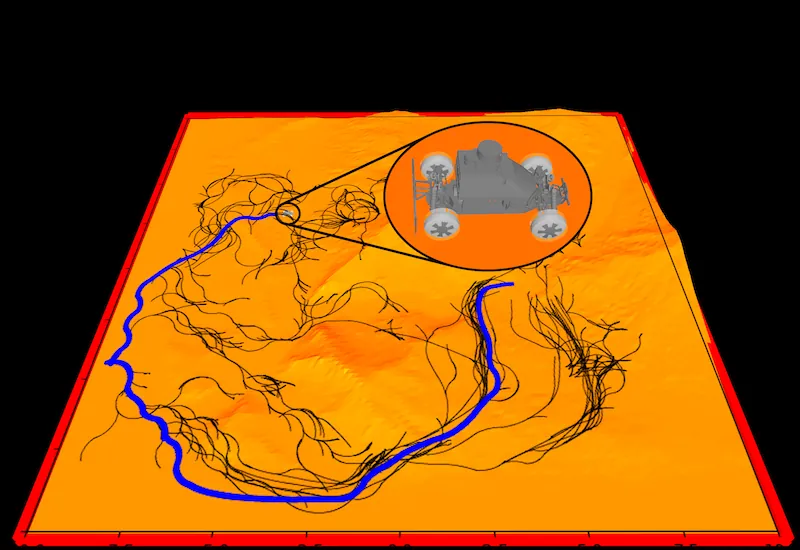
Speeds up planning for robots with complex dynamics by connecting a learned controller through a precomputed roadmap. Tested on vehicles driving over uneven terrain and on a quadrotor.

MORALS: Analysis of High-Dimensional Robot Controllers via Topological Tools in a Latent Space

Ewerton R. Vieira*, Aravind Sivaramakrishnan*, Sumanth Tangirala, Edgar Granados, Konstantin Mischaikow, Kostas E. Bekris
Proceedings of the IEEE International Conference on Robotics and Automation (ICRA), 2024 · * Equal contribution
Finalist, ICRA 2024 Best Paper Award in Automation

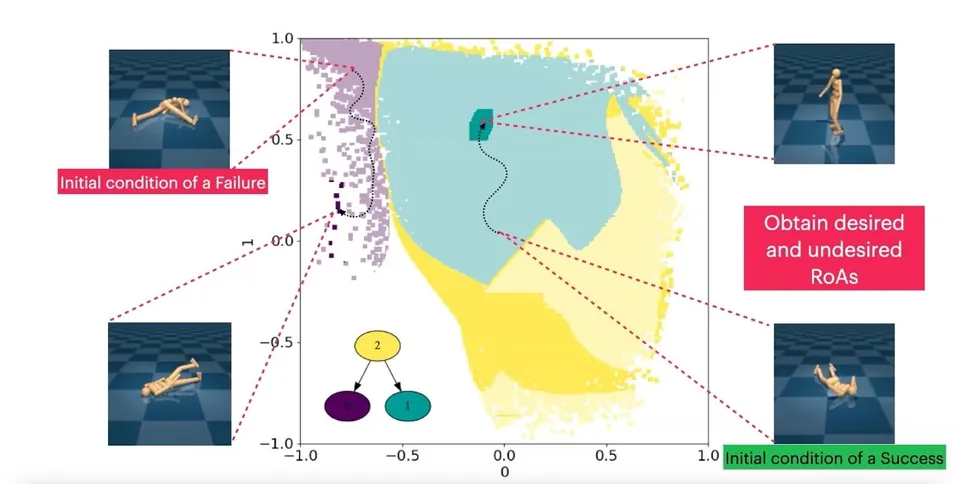
Estimates from data where a robot controller succeeds, known as its region of attraction, by analyzing its dynamics in a learned latent space. It scales to a 67-dimensional humanoid and a 96-dimensional three-fingered manipulator.

My roleProposed and implemented a label-based contrastive training variant.

Earlier work

Stacked Autoencoder Based Feature Extraction and Superpixel Generation for Multifrequency PolSAR Image Classification

Tushar Gadhiya, Sumanth Tangirala, Anil K. Roy
Proceedings of the International Conference on Pattern Recognition and Machine Intelligence (PReMI), 2019

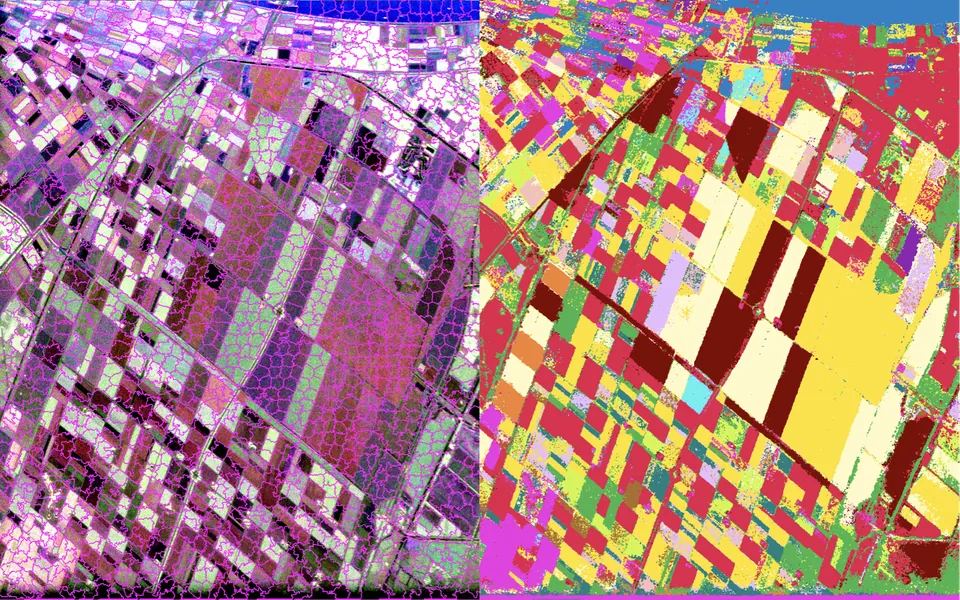
Classifies land cover in multifrequency radar (PolSAR) images using autoencoder features and superpixels.

Experience

Rutgers University

Rutgers University

Graduate Researcher, PRACSYS Lab
Feb 2023 – Present
  • Developing data-driven reachability methods that use only rollouts to estimate where black-box robot controllers reach their goals without failing, including under stochastic dynamics.
  • Mentoring students in the lab, including on building robot hardware: a YOR open-source bimanual mobile manipulator, and a cartpole actuated by a UR5e arm.
  • Helped build an external perception system for the lab's MuSHR robots, used to train closed-loop control policies for mobile robots.
Zoox

Zoox

Prediction Intern (Research)
Jun 2025 – Sep 2025
  • Owned a project to reduce how much simulation it takes to validate the autonomy stack, by estimating its performance metrics from a subset of the logged scenarios instead of all of them.
  • Modeled each metric as a Gaussian process over scenario embeddings and used Bayesian optimization to sample the rare events those metrics depend on, then compared this with stratified sampling.
  • The result was negative. Embeddings rich enough to predict the metrics were too high-dimensional for GPs to model well, and compressing them lost the signal.
Tekion

Tekion

Software Engineer (intern, then full-time)
Jan 2020 – Jul 2022
  • Led the development of dealership management modules, including Kanban repair-order dashboards and vehicle history, and led the multilingual support work for global expansion.
  • Trained 25+ interns and mentored junior developers in React and Redux.
ISRO

ISRO

Research Intern
May 2019 – Aug 2019
  • Trained an RNN-LSTM to separate groundnut and cotton fields from other land cover in radar satellite imagery, at 91.2% accuracy.
DA-IICT

DA-IICT

Research Assistant, Smart City Lab
Sep 2018 – Dec 2019
  • Developed deep-learning methods for segmenting and classifying radar (PolSAR) images, including a stacked-autoencoder and superpixel approach published at PReMI 2019.

Methods & tools

Verification & reachability
Reach-avoid analysis · Regions of attraction · Statistical verification · Stochastic dynamics · Rare-event sampling (Bayesian optimization)
Learning
Reinforcement learning · Behavior cloning · Generative models (flow matching, diffusion)
Uncertainty
Epistemic vs. aleatoric uncertainty · Active learning · Deep ensembles · Conformal prediction
Planning & control
Kinodynamic motion planning · Feedback control · System identification
Tools
Python · C++ · PyTorch · ROS · MuJoCo · Isaac Gym

Education

PhD in Computer Science

Rutgers University
2024 – Present

NSF-NRT SOCRATES Fellow (2024 – 2026)

MS in Computer Science

Rutgers University
2022 – 2024

Thesis: Safety and Efficiency for High-dimensional Robots: Integrating Learning, Planning, and Control

Outstanding Project and Outstanding Publication Awards from Rutgers CS for MORALS (2024)

BTech in Information and Communication Technology

DA-IICT (now Dhirubhai Ambani University)
2016 – 2020

Contact

Expected to graduate in May 2029, and open to internships and collaborations.